
Learn
What is open loop ticketing and account based ticketing?
Open loop ticketing lets passengers pay with the contactless bank card, phone or watch they already carry, and account based ticketing works out the fare in a back office account, with the card as its key. This guide explains both, with numbers from live cities.
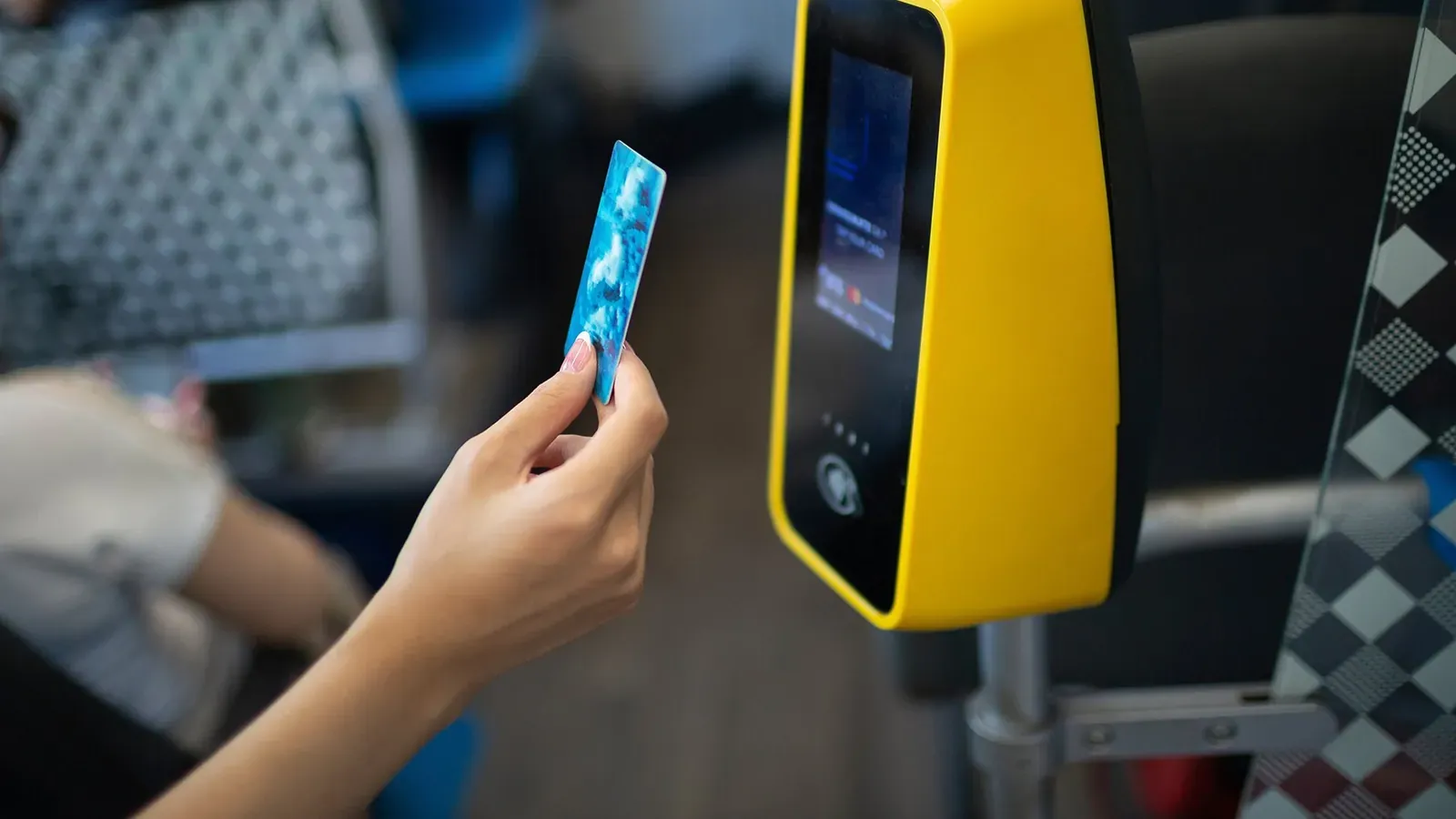
Open loop and account based ticketing, defined
Open loop ticketing means passengers pay the fare with the contactless bank card, phone or watch they already carry, and account based ticketing means the fare is worked out in a back office account, with the card serving only as a token that identifies the account. Open loop is about the payment medium. Account based ticketing is about where the ticket lives, on a server instead of in the chip of a transport card.
The two are often combined, but not always. The simplest open loop setup is pay per tap, where each tap buys one ticket at a known price, such as the flat €1 single ride in Kaunas. In account based ticketing the validator only records the tap, and the back office charges the best fare for the day or the period. German projects call this ID-based ticketing (IDBT).
Account based ticketing does not need bank cards either. An operator card or a QR code can be the key to the same account.
Closed loop, open loop and account based compared
In a closed loop system the operator issues its own fare media, such as MIFARE or DESFire cards, and the value or the product sits on that medium. The table compares the three models.
The tariff drives the choice. A flat or single zone fare fits pay per tap, because the price is known at the tap. Transfers, distance based fares and daily or weekly caps need account based ticketing when passengers pay by bank card, because the price depends on later taps. Open loop is usually added next to the existing media. Kaunas kept its electronic ticket card and app, and Ventura County kept cash and its VCbuspass cards.
| Criterion | Closed loop | Open loop, pay per tap | Account based ticketing |
|---|---|---|---|
| What the passenger uses | An operator card or ticket | A contactless bank card, phone or watch | A bank card, phone, operator card or QR code |
| Where the ticket lives | On the card | In the payment, one tap buys one ticket | In a back office account |
| When the price is set | At the validator | At the tap, as a flat or single zone fare | After the taps, with best fare and capping |
| Issuing and top-up | The operator issues and tops up cards | None, banks issue the cards | None for bank cards |
| Payment side | Run by the operator, outside the card schemes | An acquirer processes each tap under the schemes' transit rules | A fare engine sets the amount and an acquirer processes the aggregated payment |
| Best for | Operators whose passes and concessions depend on their own media. | Flat fares, occasional riders and a first step next to existing cards. | Networks with zones, transfers, time based tickets and caps. |
How a tap becomes a fare
The validator, also called a transit reader, is a card present EMV terminal in the vehicle or at a gate. Its cEMV reader, the contactless EMV reader, reads the card or phone. The validator checks that the card is genuine with EMV offline data authentication, checks it against the operator's deny list and records the tap with time and place.
The back office groups the taps by card, applies the tariff and calculates the fare. With fare capping, the total charged in a period stops at the price of an existing pass, such as a daily or weekly ticket. Freyung-Grafenau picks the best fare from each passenger's travel history, with discounts for periods of up to 30 days.
Taps are often aggregated, typically over a day, into one payment that goes through the acquirer. Aggregation lowers the fees per ride, while a longer period raises the amount at risk if the card is declined. Inspectors check tickets by reading the same card or phone, as in Budapest and Zlín.
Offline acceptance at the validator
A shop terminal usually waits for the issuer's approval. A validator cannot, because boarding does not wait for an online round trip and a moving vehicle does not always have a connection. It accepts the tap after its local checks and requests the authorisation later, shortly after the tap or at the end of the aggregation period.
This creates first ride risk, because a decline arrives after the ride. The card schemes' transit rules, Visa MTT and Mastercard PAYG among them, make the issuer cover a declined first ride up to a threshold and define how the rest is recovered. The declined card goes onto the deny list until the fare is paid, through the passenger's next tap or through permitted retries.
Operator, acquirer and integrator
The transit operator is usually the merchant. It sets the tariff and the capping and aggregation rules, owns or leases the validators, and runs inspection, refunds and the customer portal, where BKK in Budapest lets passengers see their trips and download receipts.
The acquirer processes the authorisation and settlement of the fares and pays the net amount to the operator. Not every acquirer handles transit transactions, so the operator has to confirm that its acquirer does. Acquirers in the projects below include Elavon in Kaunas, NLB with processor Bankart in Ljubljana, ČSOB in Zlín, Shift4 in Schweinfurt and BancoEstado in Valparaíso.
Validator suppliers and system integrators complete the chain, such as Margento in Slovenia, Future Technologies in Zlín and krauth technology in Schweinfurt. The payment platform connects the validators to the acquirer and, in account based systems, feeds the fare engine.
What cities report
These results come from live contactless ticketing deployments on the Switchio platform.
- Kaunas in Lithuania launched on 1 August 2025 with 800 validators on 140 trolleybuses and about 300 buses. One tap buys a €1 single ride, with no registration or app.
- In Slovenia, open loop runs in Ljubljana, Koper, Piran and Maribor, which added 75 validators. LPP in Ljubljana reports higher ridership and few declined transactions.
- Regensburg in Germany moved from manual fare selection on the validator to one tap for a single zone adult ticket, first on five test buses.
- Schweinfurt in Germany is fitting all its vehicles with 134 terminals, krauth validators with Feig EMV readers, for check in and check out.
- Zlín in the Czech Republic runs 340 validators. In 2023 it collected 9,527 kg of coins from ticket machines and sold over 3.6 million paper tickets, costs it expects to cut.
- Ventura County in California has run its first open loop fare system since June 2025, on 41 buses, with pay as you go discounts for frequent riders.
- Valparaíso in Chile offers one mobility ticketing across buses, trolleybuses, elevators and the Limache-Puerto train, and later added 26 Biotrén stations in the Biobío Region with 244 terminals.
- Freyung-Grafenau in Bavaria runs ID-based ticketing with best fare calculation and fare capping for a district of some 80,000 inhabitants.
How Switchio does it
Switchio provides the EMV certified open loop platform behind these projects, from the validator to the acquirer. It runs on the same payment orchestration platform as retail and EV charging, with multi acquirer routing, failover, a terminal management system for validators and central reporting.
The platform accepts EMV cards offline within configurable risk limits and collects the funds once the connection is back. Several connected acquirers are marked ready for Visa MTT and Mastercard PAYG, and open loop runs next to MIFARE and DESFire cards. The transport page lists the cities and validators.
Tell us about your tariff and your validators, and our mobility team will show you how open loop and account based ticketing would run on them.
Talk to an expertQuestions people ask
What is the difference between open loop and account based ticketing?
Open loop describes the payment medium, a contactless card, phone or watch issued by any bank. Account based ticketing describes where the fare is calculated, in a back office account that groups all taps of one card.
Do passengers need to register or install an app?
No. The passenger taps and boards, and the back office recognises the card on every tap. Kaunas and Budapest, for example, require no registration.
How does a validator accept a card without a connection?
It checks the card with EMV offline data authentication and against the deny list, accepts the tap and requests the authorisation later. A card that is then declined goes onto the deny list until the fare is recovered.
What is fare capping?
Fare capping limits what a passenger pays in a period to the price of an existing pass, such as a daily or weekly ticket. Once the cap is reached, further taps in that period cost nothing extra.
- What is payment orchestration?Payment orchestration is a software layer that sits between the places where payments are accepted and the acquirers that process them, and decides for each transaction where it goes. This guide explains it for terminals, SoftPOS phones, kiosks and transit validators.
- What is the difference between payment orchestration and a payment gateway?A payment gateway carries a transaction to an acquirer, while payment orchestration decides which acquirer should receive it and moves it to another one when the first is unavailable. This guide compares the two for in-person payments.
- What is a payment switch and how does it work?A payment switch is the system that receives authorisation requests from terminals and other devices, decides where each one should go and forwards it to the acquirer in the protocol that side expects. This guide covers what it does, its architecture and how to choose one.
Talk to Us
Connect with our team.
Share your current setup with us, and we’ll map out how it looks on one streamlined platform.
Other ways to reach us
Email
info@switchio.comPhone
+420 577 110 411
