
Learn
In-person payment glossary
An in-person payment glossary defines the terms used when a card, phone or watch pays at a counter, kiosk, validator or charger. This one runs from acquirer to white label and covers terminals, routing, security standards, transit and EV charging.
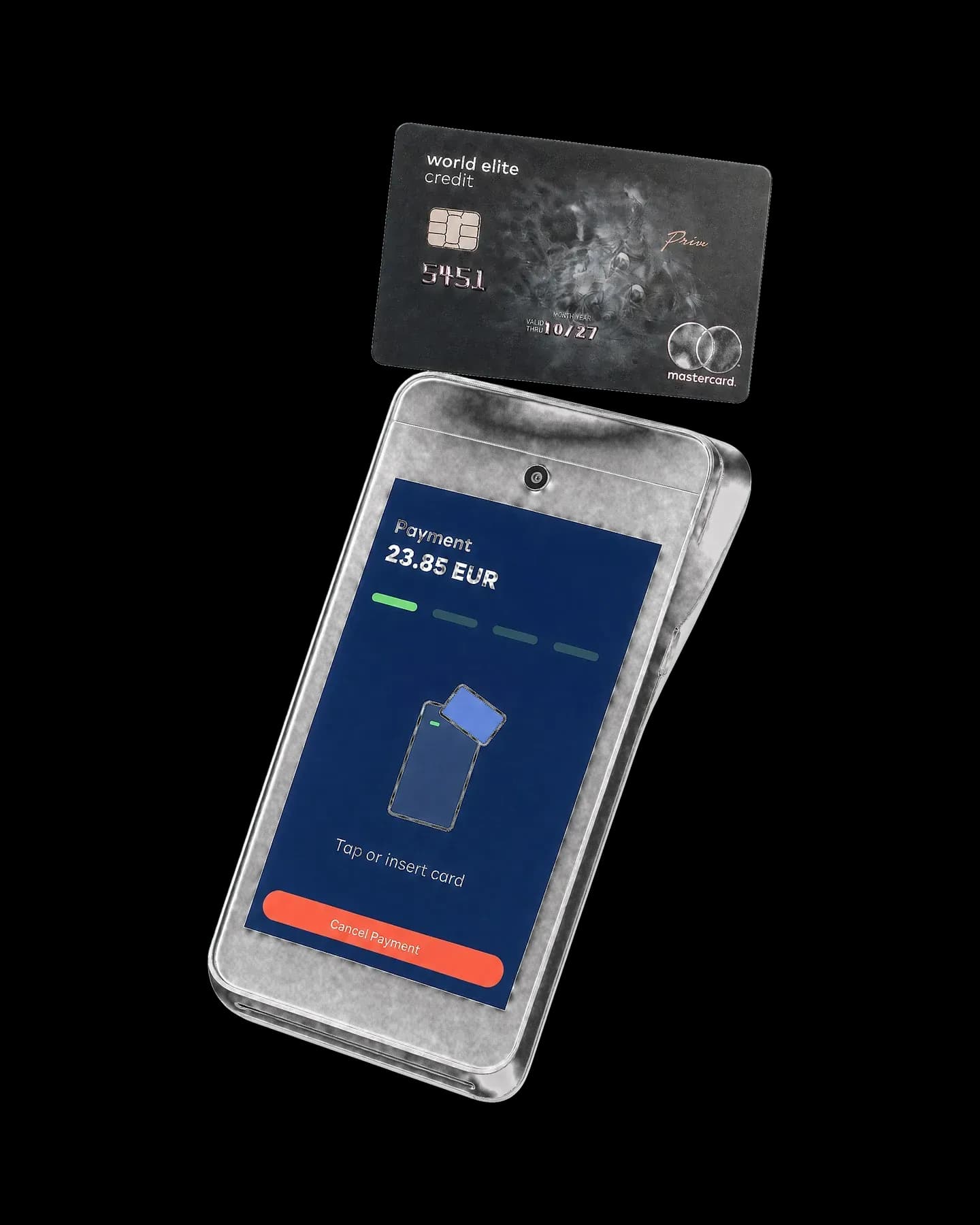
About this glossary
An in-person payment glossary defines the terms that describe how a card, phone or watch pays at a counter, a kiosk, a validator or a charger, and how that payment travels from the terminal to the acquirer. The entries below are grouped by first letter and cover contactless payment solutions, routing, terminal management, security standards, transit and EV charging. For the bigger picture, start with what payment orchestration is.
A
Account based ticketing
A fare collection model in which the ticket lives in a back office account, and the card, phone or other token only identifies that account at the validator. The back office groups the taps and calculates the fare afterwards, which allows zones, transfers and fare capping without the passenger choosing a ticket. The open loop and account based ticketing guide explains how it works.
Acquirer
The bank or licensed payment institution that contracts with a merchant to accept card payments, sends the transactions into the card schemes and pays the merchant, net of fees. A merchant can work with one acquirer or with several at once.
AFIR (Alternative Fuels Infrastructure Regulation)
The EU regulation on infrastructure for alternative fuels, which requires publicly accessible charge points to accept ad hoc payment without a contract. Since 13 April 2024, new charge points of 50 kW and more need a card reader or a contactless device that reads payment cards, and from 1 January 2027 the duty extends to existing charge points, with the exact scope set by power output and location. Payments for EV charging covers what this means for operators.
Alternative payment method (APM)
Any payment method outside the international card schemes, such as account to account (A2A) payments, QR code wallets like Alipay and WeChat Pay, or local mobile payment schemes. On an orchestration platform, APMs can run through the same terminal and transaction lifecycle as cards.
Authorisation
The request that asks the card issuer to approve a payment for a given amount, sent from the terminal through the acquirer and the card scheme. An approval confirms the card is valid and reserves the funds, while the money itself moves later in settlement.
C
Card present
A transaction in which the card, or a phone or watch carrying it, is at the terminal and is read by chip, contactless or magnetic stripe. In-person payments are card present and follow different security and liability rules from online, card not present payments.
cEMV
Contactless EMV, the EMV standard for tap payments with cards, phones and wearables. In transit and EV charging the term usually means the contactless EMV reader built into a validator or charger, which turns it into a card acceptance point.
Closed loop
A payment or fare system whose media work only within one operator or a group of partners, such as a transport operator's own card or a store gift card. The operator issues the media and handles the clearing itself, outside the card schemes.
Contactless payment terminal
A payment terminal with an NFC reader that accepts contactless cards, phones and wearables, usually next to chip and magnetic stripe. It can be a countertop, handheld or unattended device, an Android smart terminal or a phone running SoftPOS, so a tap to pay terminal no longer has to be dedicated hardware.
D
DCC (dynamic currency conversion)
A service that lets a cardholder with a foreign card pay in their home currency instead of the local one. The terminal shows the exchange rate and the cardholder chooses, and the merchant and acquirer earn from the conversion margin.
DUKPT (Derived Unique Key Per Transaction)
A key management method defined in ANSI X9.24, in which the terminal derives a new key for every transaction from an initial key injected into it. A key captured from one transaction does not expose earlier or later ones.
E
ECR (electronic cash register)
The merchant's till or point of sale system. ECR integration connects it to the payment terminal, so the amount goes to the terminal and the result comes back without retyping, over a local protocol such as IFSF, an app to app call on an Android terminal or a cloud API.
EMV
The global specification for chip and contactless card payments, named after Europay, Mastercard and Visa and managed by EMVCo, which American Express, Discover, JCB, Mastercard, UnionPay and Visa own together. EMV cards prove they are genuine with cryptography, which makes them much harder to copy than magnetic stripe cards.
EMV Level 3 certification
The final test of a terminal and its payment application with a specific acquirer and card scheme, after the hardware (Level 1) and the EMV kernel (Level 2) have been approved. A new terminal model or a new acquirer connection usually needs Level 3 before it goes live.
F
Failover
Automatic rerouting of a transaction to a backup acquirer, processor or data centre when the primary one does not answer. With failover in place, an outage at one provider does not stop the sale.
Fare capping
A rule that limits what a passenger pays in a period to the price of an existing pass, such as a daily or weekly ticket. Once the cap is reached, further rides in that period cost nothing extra.
Fleet card
A payment card that companies give their drivers for fuel and vehicle services, issued by fleet card issuers such as DKV, Eurowag, UTA or AS24. Many fleet cards run on the issuer's own network, so a fuel station needs a connection to each issuer, which a switch can provide on the same terminal that takes bank cards.
I
IFSF
The International Forecourt Standards Forum, an association of fuel retailers and their suppliers that publishes open interface standards for fuel stations. Its protocols link forecourt systems, the point of sale and payment, and IFSF is also one of the protocols that connect a cash register to a payment terminal.
ISO 8583
The international standard for card originated financial messages, which most acquirer and processor host interfaces are based on. Each message carries a type indicator, a bitmap of the fields present and data elements such as the amount, card data and the response code.
Issuer
The bank or financial institution that gives the card to the cardholder, approves or declines its authorisations and charges the cardholder's account.
K
Key injection
Loading the cryptographic keys that protect PINs and card data into a terminal's secure hardware. It happens in a secure key injection facility before the device ships, or remotely where the device and the host support remote key loading.
M
MPoC (Mobile Payments on COTS)
The PCI SSC standard for accepting card payments with PIN or contactless on commercial off the shelf devices such as phones and tablets. It builds on the earlier CPoC and SPoC standards, and SoftPOS solutions are certified against it.
Multi acquirer
A setup in which one merchant or terminal fleet is connected to more than one acquirer at the same time. It serves to cover several countries, to compare costs or to keep a backup for failover, and it needs a switch or orchestration layer that picks the acquirer for each transaction.
N
NFC (near field communication)
The short range radio technology, working over a few centimetres, that contactless cards, phones, wearables and payment readers use to exchange data. SoftPOS relies on the NFC chip already built into an Android phone.
O
OCPP (Open Charge Point Protocol)
The open protocol, maintained by the Open Charge Alliance, that connects EV charge points to the charging network's management system for sessions, status and remote control. Card payment at a charger is usually a separate integration next to it, linking the payment terminal with the charging backend.
Offline acceptance
Accepting a card payment while the terminal or validator cannot reach the acquirer, within configured risk limits, and sending the transaction once the connection returns. EMV cards support it with offline data authentication, and transit validators and unattended machines depend on it.
Open loop
Payment acceptance with cards and wallets issued by any bank, rather than media issued by the operator. In transit, open loop means passengers pay the fare by tapping their own contactless bank card, phone or watch on the validator.
Orchestration
Payment orchestration is a layer between payment devices and several acquirers that routes each transaction by rules, fails over when a provider is down and translates each provider's protocol. In-person orchestration does this for terminals, SoftPOS phones and unattended devices, as on the Switchio payment orchestration platform.
P
P2PE (point-to-point encryption)
The PCI SSC standard for encrypting card data from the moment the terminal captures it until it is decrypted in the provider's secure environment. A validated P2PE solution keeps readable card data out of the merchant's systems and reduces its PCI DSS scope.
PAR (payment account reference)
A non-financial identifier, defined by EMVCo, that links a card number with the tokens issued for it. It lets a system recognise that a plastic card and a phone wallet belong to the same account, which transit and loyalty programmes use.
Payment gateway
A service that carries a transaction from the merchant's terminal or system to the acquirer and returns the answer. A gateway tied to one acquirer only transports the payment, while choosing between acquirers is orchestration, as explained in payment orchestration vs payment gateway.
PCI DSS
The Payment Card Industry Data Security Standard, which sets security requirements for every environment where payment account data is stored, processed or transmitted. Merchants, acquirers and payment platforms are assessed against it, and keeping card data out of a system is the usual way to reduce what has to be assessed.
PCI PTS
The PCI PIN Transaction Security standard for devices that accept PINs and card data at the point of interaction, covering their physical and logical protection. Terminals and PIN pads that take PINs need PCI PTS approval, and PCI SSC publishes the list of approved devices.
PIN pad
The keypad on which the cardholder enters the PIN, either built into the terminal or a separate device connected to it, as in many unattended machines. It encrypts the PIN as soon as it is entered and has to be PCI PTS approved.
Pre-authorisation
An authorisation for an estimated amount, made when the final amount is not yet known and completed later with the actual amount. It is common at fuel pumps, EV chargers and hotels, and on cruise ships one pre-authorisation at boarding can cover every purchase on board.
Processing centre
A company that processes card transactions on behalf of acquirers or issuers, running authorisation, clearing and card management on its own systems. Some acquirers process in house and others through a processing centre, so a switch connects to both kinds.
PSP (payment service provider)
A company that gives merchants what they need to accept payments, such as acquiring or access to acquirers, a gateway, terminals and reporting. Many PSPs work with one or more acquirers behind the scenes, and in the EU payment service provider is also a regulated category.
S
Settlement
The movement of money after a payment. Clearing first exchanges the transaction details between acquirer and issuer, then the issuer pays through the card scheme and the acquirer pays the merchant the total minus fees.
Smart routing
Rules that decide where each transaction goes, for example by card type, amount, merchant, terminal or cost, instead of sending everything to one acquirer. The rules run on the switch, so they change through configuration without touching the terminals.
SoftPOS
Software that turns an Android phone or tablet with NFC into a payment terminal without extra hardware, also known as Tap to Phone. SoftPOS solutions are certified under PCI MPoC, and white label versions let a bank or PSP launch one under its own brand, as with Switchio SoftPOS.
Switch
A payment switch receives authorisation messages from terminals, decides where each one should go and forwards it to the acquirer or processing centre in the protocol that side expects. It is the core of an orchestration platform, and the payment switch guide shows how it works.
T
Tap to pay
Paying by holding a contactless card, phone or wearable near the reader, which runs an EMV contactless transaction over NFC. A tap to pay terminal can be a dedicated contactless payment terminal or a phone running SoftPOS.
Terminal fleet
All the payment terminals an organisation runs, across locations, models and countries, managed as one unit. How to manage a large fleet of payment terminals covers the tools and the rollout process.
TMS (terminal management system)
Software that keeps every payment terminal in a hierarchy and manages it remotely, from live status, parameters, firmware and applications to keys and batch onboarding, with role based access and change logs. Terminals pick up changes on their next call to the TMS.
Tokenisation
Replacing the card number with a substitute value, the token, so that systems can work with the payment without holding the real number. In EMV payment tokenisation the token stands in for the card number in phone wallets. Merchants and platforms also use their own tokens to recognise returning cards, refund deposits to the card or keep back office systems out of PCI DSS scope.
U
Unattended payment
Card acceptance in machines that nobody staffs, such as vending machines, kiosks, parking columns, EV chargers and reverse vending machines. It needs terminals certified for unattended use, remote monitoring because nobody is there to restart a device, and defined behaviour when the connection drops.
V
Validator
The device in a vehicle, at a gate or on a platform where passengers tap to pay or to record a trip, also called a transit reader. An open loop validator contains a contactless EMV reader and checks each card locally, so boarding does not wait for an online authorisation.
W
White label
Software or a service delivered under the partner's brand instead of the provider's, such as a payment application, a SoftPOS app or a merchant portal showing a bank's logo and colours. The provider stays invisible to the merchant.
If a term from your project is missing here, our team will explain how it applies to your fleet.
Talk to an expertQuestions people ask
What is the difference between an acquirer, a PSP and a processing centre?
The acquirer holds the merchant contract, sends transactions into the card schemes and pays the merchant. A PSP packages payment acceptance for merchants and often works with one or more acquirers behind the scenes. A processing centre runs transaction processing for acquirers or issuers and usually has no contract with the merchant.
What is the difference between a contactless payment terminal and SoftPOS?
A contactless payment terminal is dedicated hardware with an NFC reader, usually with a chip reader and a PIN pad as well. SoftPOS turns an ordinary Android phone with NFC into the terminal under PCI MPoC certification and takes taps rather than inserted cards. Both accept the same contactless cards and wallets.
What is the difference between open loop and closed loop payments?
Closed loop media, such as a transport operator's card or a gift card, work only in the system that issued them. Open loop means accepting cards and wallets issued by any bank, so people pay with what they already carry. The two can run side by side on the same validators or terminals.
Which PCI standards apply to in-person payments?
PCI DSS covers every environment that stores, processes or transmits card data. PCI PTS covers terminals and PIN pads, PCI P2PE covers encryption from the terminal to the decryption environment, and PCI MPoC covers card acceptance on phones and tablets.
Sources
- PCI Security Standards Council, standards overview (PCI DSS, PTS POI, P2PE, MPoC)
- EMVCo, overview of EMVCo
- EMVCo, EMV Payment Tokenisation and Payment Account Reference
- Cal-ITP, A Guide to Payment Processing, definitions of open and closed loop, capping, PAR and validator (January 2025)
- Visa Acceptance Solutions, mass transit terminology (offline data authentication, validator)
- What is payment orchestration?Payment orchestration is a software layer that sits between the places where payments are accepted and the acquirers that process them, and decides for each transaction where it goes. This guide explains it for terminals, SoftPOS phones, kiosks and transit validators.
- What is the difference between payment orchestration and a payment gateway?A payment gateway carries a transaction to an acquirer, while payment orchestration decides which acquirer should receive it and moves it to another one when the first is unavailable. This guide compares the two for in-person payments.
- What is a payment switch and how does it work?A payment switch is the system that receives authorisation requests from terminals and other devices, decides where each one should go and forwards it to the acquirer in the protocol that side expects. This guide covers what it does, its architecture and how to choose one.
Talk to Us
Connect with our team.
Share your current setup with us, and we’ll map out how it looks on one streamlined platform.
Other ways to reach us
Email
info@switchio.comPhone
+420 577 110 411
